Paperback · Hardback · eBook
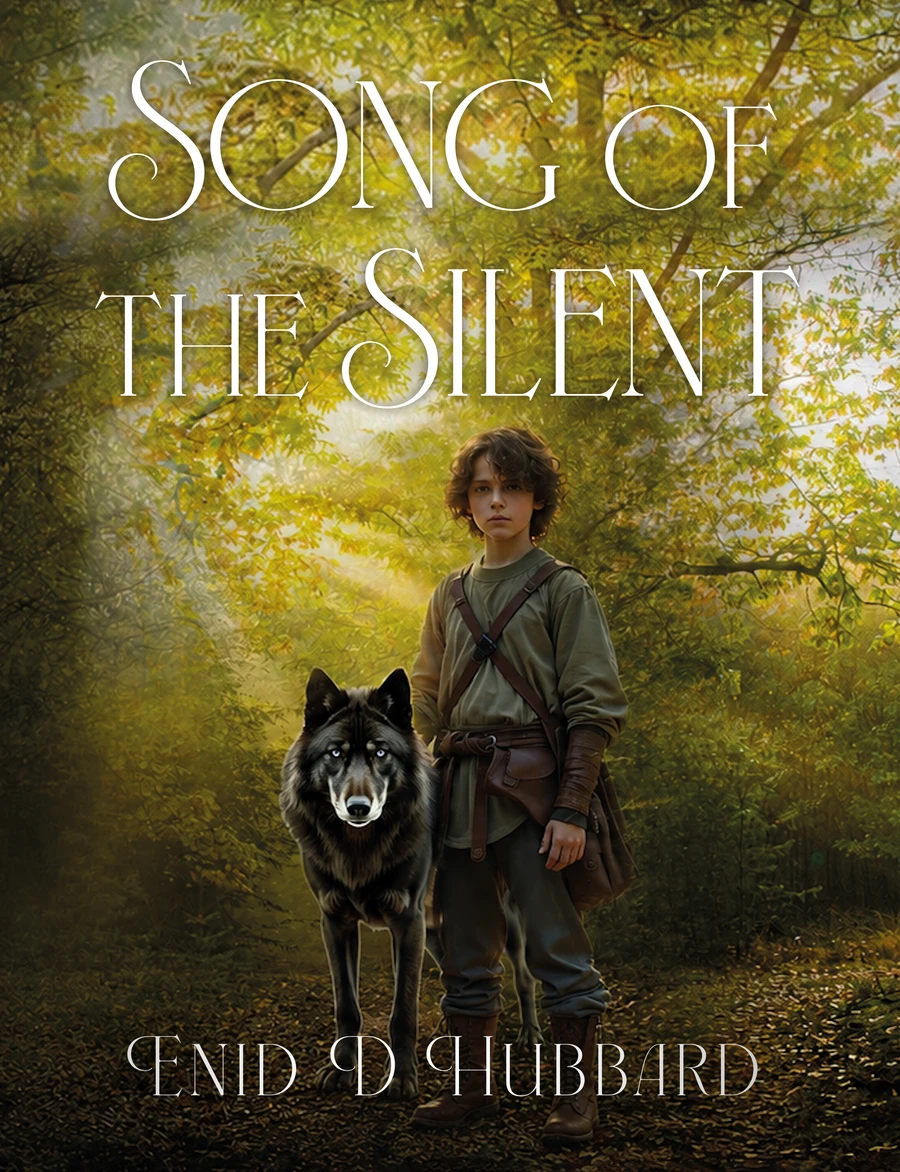
A novel by Enid D Hubbard
Song of the Silent
A country has been sealed from the rest of the world. Peace and security have been taken for granted. Generations pass and an old insurrection becomes resigned to history.
Beyond their borders, a wound seethed and itched until it burst. The infection festered and grew into an all-consuming desire for power, regicide and revenge.
The peoples of the land must unite. Who will stand against their enemies? Who has the power to resist and fight? Who will lead them? Where is the hero?
The tale of many lives unfolds in Song of the Silent. Their journey begins. Travel with them.
Published by Troubador · 28 September 2026
Read the opening chapter
Every journey has a beginning
Chapter One: Foundling. Read at your own pace, turn the pages and adjust the type size to suit you.
Chapter One
Foundling
The sun was about to set. It was almost firstnight and a thick frost coated the ground. A chill wind bent the hedge into spindly twig fingers that clutched at passing strangers, warning them of the coming darkness and the terrors of the night. Two figures were hurrying along the lane muffled against the cold.
‘I don’t see why we have to come this late; it’s not as if it’s going to make any difference.’
The woman was clearly in a bad mood.
‘He’s been a good neighbour,’ the man replied softly.
‘Been? Yes, been, that’s just the point. He won’t be for much longer, will he?’
The sharpness of the woman’s reply stung more than the wind on his face, but the man swallowed his protest. They walked in silence along the length of the track which led to the house. When they reached the farmyard gate the man held it open.
‘And don’t think we’re bringing that child home with us.’ The woman gripped the ends of her scarf and tied them tighter under her chin.
‘But my dear…’
‘Don’t “dear” me. Ava I was named, and Ava I will always be, not dear. And while we’re talking about names, what’s his name?’ She smiled smugly knowing this was one question the man could never answer.
‘I don’t know what his name is. The old man always calls him “the boy”. You know that Ava.’ The man sighed. She always asked the same question, and he always gave the same answer. He even knew what she would say next.
‘Well, whoever heard of anyone being called “boy”? Every other child I know has got a name. You have a name, I have a name, and if his own grandfather doesn’t know his name it just proves there’s something wrong with the child.’ She moved closer to the man, and he could feel her hot breath on his cold face. ‘I knew he was an idiot the first time I saw him.’
‘You’ve only seen him twice.’
‘Once was enough.’ Her eyes, bright with indignation, bored into the man’s soul and he looked away. ‘And whoever heard of an old man raising a baby in the first place? It wasn’t right. A baby needs a mother.’ She used her fingers to count. ‘That child has been here these past nine harvests, and I’ve only seen him twice. If there’s nothing wrong with him why does the old man keep him hidden at the farm? Oh, he’s an idiot all right.’ She folded her arms and dared the man to disagree.
‘He’s not an idiot. He’s just deaf.’
‘Just deaf?’ The woman’s voice was becoming shrill and piercing. ‘There’s more than “just deaf” wrong with him. That child is bad, and I won’t have him in my house no matter what you promised the old man.’ Her lips set in a thin pink line, and she slammed the gate shut behind them. Neither spoke until they reached the farmhouse door.
‘And there’s no sense in knocking,’ Ava said curtly as the man lifted his knuckles to the door. ‘Who’s going to hear you?’
She barged past him, flung open the door, and headed upstairs to where the old man was lying on his deathbed. With luck he would die quickly, and she could lay him out and be home before moonrise.
*
The boy sat in the corner of the kitchen. You would not have known he was there if you had casually glanced into the room; only on closer inspection would you catch sight of the white pallor of a face that revealed his hiding place in the shadows. He was motionless, his knees drawn up under his chin and his arms folded round them. His slim tapered fingers gripped his hunched shoulders with white-knuckled fear. Solemnly he stared at the door, waiting to be discovered. He sat in silence trying to make some sense of what was happening. People had come from the village when Grandfather had not arrived at market. When was that? He wasn’t sure. He only remembered being pushed away when they had carried Grandfather up to his bed and Grandfather had been in his bedroom for such a long time. Why were they keeping him up there? There was no one to give him answers; no one knew he was there. The pallid light from the parlour lamp which seeped under the door was deepening to a golden glow as night approached. The boy’s head fell forwards onto his knees, and he slipped briefly into a world of dark dreams.
*
When he woke it was deepnight. Through the kitchen window he could see a full moon being dragged into the sky-net of stars. Then he noticed the parlour lamp had gone out. Painfully he uncurled his numb fingers, stood, and then stretched. Soundlessly he crossed the floor and opened the door. The front parlour looked as it always did. The table and chairs stood as they had always stood, and Grandmother’s portrait smiled down from the wall. Through the open curtains moonbeams began to creep over the old red carpet. The house was at peace, and the boy turned to the stairs. Like a small forest creature, he climbed swiftly to the top. Not one board resisted his footfall, not one sound betrayed his closeness to Grandfather’s room. His small white hand slowly turned the comforting brass door handle, and he peeped inside.
Moonlight rippled across the floor as it shone through the waving branches of the chestnut tree in the yard. The boy stopped, and a slight sigh passed his lips. Yes, Grandfather was there sleeping soundly in his bed. The boy was about to leave so as not to wake the old man when his eyes were drawn to his grandfather’s hands. They were hands that held you when you jumped; hands that ruffled your hair; hands that drew the water from the well; hands that worked and made wonderful things; hands that were never still but were now folded and motionless upon his chest.
The boy went closer, his steps faltering as uncertainty pulled at his heels. He reached out and touched his grandfather’s cheek; it was cold, so very cold. The boy waited, but the old man never stirred. One large tear rolled down and splashed a farewell kiss upon the old man’s lips and then the boy ran from the room.
Grabbing his small satchel from behind the door he threw himself into the night. The yard was lit by the pale moon and the long grey shadows of outbuildings danced in the wind as he pushed open the gate and stumbled through. He crossed the track and leapt the stile; he ran across fields falling between the uneven furrows and crawled through the bordering hedges. Bruised and torn, he ran through brambles and nettles, pasture, and meadow. He staggered along the sheep trail and scrambled up the small hill behind the farm and did not stop until he was heaving from lack of breath; until a stabbing red-hot pain seared his lungs and he was close to exhaustion. Then he fell against the old woodpile high above the cottage and buried his head in his hands. He sobbed great gasping sobs mourning his grandfather, knowing there was no one to look after him, nowhere to live, and nowhere to go.
As the sharp edge of grief was dulled the boy became aware of pinpoints of light shining within the depths of the woodpile. Looking closer he saw several pairs of tiny green eyes looking back at him. Slowly the eyes came closer through the overlapping logs until suddenly out into the moonlight came the wood sprites. They tumbled and laughed and fell over each other in their eagerness to greet the boy. Their bark-like skins shimmered in the moonlight and the boy had named them after the trees they resembled. They waited impatiently for the boy to join in their adventures. Standing only as high as the boy’s knee they clutched at his clothes trying to pull him towards the trees, but the boy was in no mood to play their games and rubbed at his eyes to scrub away the tears that, unbidden, were coursing down his face as an uncontrollable wave of grief engulfed him again.
Willow, greener than the others and the smallest of the five, jumped onto the woodpile to comfort the boy. Oak, sturdy and dependable, stood, silently watching. He was their leader and the other four deferred to his judgement. The sprite was anxious and becoming increasingly alarmed, but it was not until he looked down at the unusually darkened farmhouse that he realised what had happened.
‘It is time,’ Oak told the others softly. ‘The old man is dead. We are no longer just the boy’s companions; we are now his protectors as well.’
The younger sprites’ mood immediately changed to a sombre anticipation as they waited for the boy’s sobbing to subside. Once he had calmed down the boy allowed the sprites to pull him along and before he knew what was happening, he was running beside them in a strange dance across the moonlit countryside eager to leave his grief behind him.
*
The moon had begun to dip behind gathering clouds when they came to the eaves of the forest. Here the boy lingered at the edge of the enveloping darkness; despite the sprites’ encouragement he would not step into the trees because he had never been into the forest without his grandfather. The sprites darted along the trail and then ran back beckoning him urgently to join them, but he would not move. The boy shivered, and he was suddenly aware of the cold of deepnight mingling with the chill of his grief. He wanted to cry, but there were no tears left. He thrust his hands into his pockets and turned away.
Before he had taken a single step something brushed against his legs and spun him round to face the trees. It was the slightest touch yet had a power he could not resist. He peered into the forest waiting for his eyes to adjust to the darkness, trying to see who or what was responsible. Then he saw it: a deeper shade of grey flecked with silver almost lost against the trees. Grandfather once had a hunting dog, but this creature was different; it was bigger and far more powerful. The boy remembered the pictures in his grandfather’s book and the word ‘wolf’ seemed to fit the beast. Wolves lived high in the rocky crags far away from men who hunted in the lower forests so the boy did not know he should have been afraid. The wolf stood waiting and the boy knew it was waiting for him. His curiosity dulled the pain of his grief, and he walked forwards drawn towards the creature by an inexplicable bond. The wolf stood impassive, accepting the boy’s touch as his fingers sank into soft, lustrous, thick fur. The boy smiled; with a wolf beside him he knew he would be safe. At a sign from Oak the sprites led them deeper into the forest. Here the trees grew closely together. Quickly and quietly, they disappeared into the gloom.
The boy lost track of time as they walked in darkness beneath the dense leafy canopy not knowing that, beyond the forest, another day had dawned. He was unaware that sunlight streamed across the fields of his grandfather’s farm as neighbours arrived to bury him, and if anyone ever looked for the boy or cared about him it is not recorded here.
They walked in silence. At times the wolf would stop, and the sprites would disappear into the trees. Then the boy would sit beside the narrow track and doze while he waited for their return. At first the boy wondered where they went or what they did, but their disappearances gradually became an accepted part of his routine. The wolf never allowed him to stray from the pathway and he soon became accustomed to walking, stopping, waiting, and resuming their journey. Chestnut and Beech brought him berries, nuts, and roots to eat, and Hazel showed him how to crack open the nutshells. The wolf, however, ate nothing, but was at all times alert and wary.
After several days the forest thinned. At the edge of the trees there was a meadow that had not seen a scythe for many a year. The boy wanted to cross the meadow but sensed the wolf was waiting for the sprites to make sure the path was safe. When they returned, Oak put his finger to his lips then beckoned the boy forwards. On the far side of the meadow was an unkempt lane which they followed for a short way until the wolf turned aside. Holding tight to the beast’s neck ruff the boy walked through a copse of close-grown saplings that gradually gave way to older woodland and ended abruptly at a steep rock face overgrown with creepers and flowering vines.
If the wolf had not stopped, the boy would never have seen the door which was almost completely hidden. It was a small wooden door, with a single window set on each side, that had been overgrown with briar rose and climbing columbine. The wolf looked up at the boy and the sprites nudged him forwards. The boy pushed open the door into a single room cut out of the rock. It contained a table, several chairs, a bed, and a fireplace. In front of the hearth there was a rug and a large bowl. A heavy brown curtain hung across one wall and the boy couldn’t resist raising the corner. Behind was a storeroom filled with tools, baskets, rope, jars of seeds, and other implements. The sprites busied themselves sweeping away the dust of time while Oak lit a fire. The boy had no idea who had lived there but when the wolf lay down on the rug in front of the fire, he knew it was now his home. He sat on the bed and, surprised at how tired he was, fell fast asleep. The sprites left closing the door behind them.
*
The seasons passed quickly. The wolf was always by his side and together they learnt the ways of the forest. Sometimes the sprites would go with them as they traced the source of a stream or looked for fish in small ponds; sometimes they went alone, the sprites often disappearing for days at a time.
The boy set about making a small garden in front of his tiny home. He cleared a patch of ground and the sprites brought sheaves of willow withies. He watched them build an elaborate living fence around the borders of his plot. They wove the branches in an intricate design that completely hid the garden from view and yet let in enough light to allow the plants to grow. It was here they would entertain him by tumbling and playing amongst the saplings during long summer days, while on winter nights they would shut out the cold and make him laugh by balancing unsteadily on each other’s shoulders making grotesque shadows dance on the walls. In time he learnt to lip read their version of the common tongue but mostly gesture and mime served them adequately in place of words.
Often when the sprites were away in the dead of winter the boy and the wolf would sit by the fire and he would empty out his small leather satchel onto the table. Within were his life-long belongings. A small, printed history of the land and the peoples who lived there, a penknife that had belonged to his grandfather, a sewing kit, and in a small soft leather purse was a gold coin. The boy had no idea of its worth, but it was bright and shiny with a picture of a dragon rampant on one side and a delicate unicorn on the other. Grandfather had given it to him the Midsummer before he died. The boy would finger it and then polished it on his jerkin before tucking it away. There was also a small book bound in red leather that had been his grandfather’s diary. The boy loved to feel the pages beneath his fingers; the smoothness of the creamy white paper etched with the old man’s neat looping handwriting brought him nearer to the memories he cherished. The diary recorded the seasons, of growing and harvesting, of folklore and signs. Deep within its pages nestled one white flower pressed long ago. Its perfume still filled the room when he held it, even though its petals were now edged with brown.
The boy was content; he had friends, food, and shelter. It would have been perfect if his grandfather had been there too.

Within the pages
A land far from home
Follow the journey with the map from Song of the Silent.
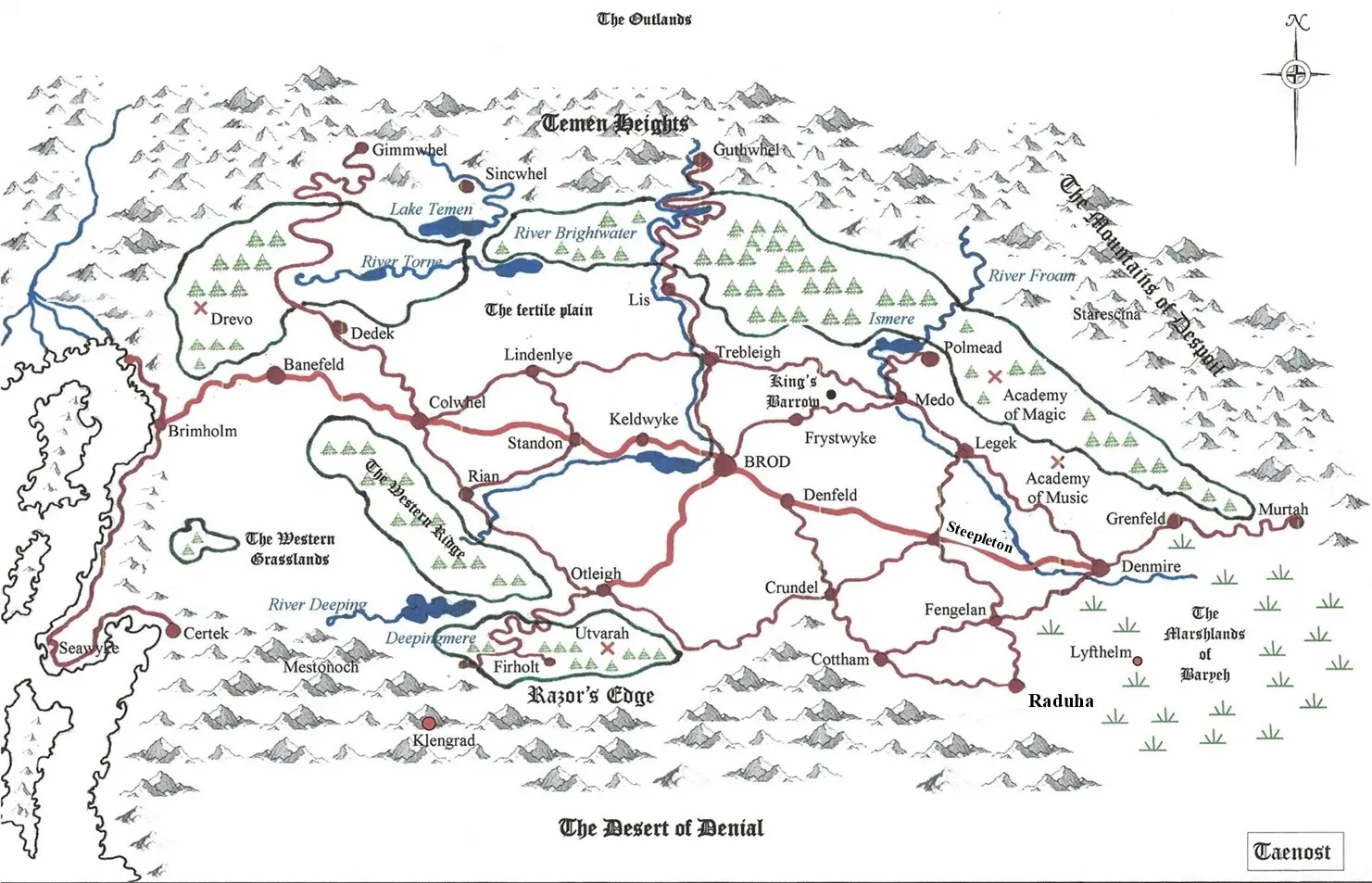
Select the map to see it in more detail.